Meta Andromeda is the system that decides which few thousand ads, out of tens of millions, get considered for each person on Facebook and Instagram. On October 28, 2026, Meta published its next generation: it evaluates more than one billion ads per second, 100 times the 2024 version, and Meta credits Andromeda with a 2.4% increase in conversions on Facebook since 2025.
For advertisers, the practical change is simple: more ads compete for every impression than ever before, and Meta’s own engineering guidance says a more diverse set of ad candidates produces better outcomes for advertisers. Brands that give the system many genuinely different ads are positioned to gain. Brands feeding it variations of one ad are not.
What is Meta Andromeda and what does it do?
Andromeda is the first stage of Meta’s ads recommendation pipeline. Meta describes retrieval as the step that selects “from tens of millions of ad candidates into a few thousand relevant ad candidates”; larger ranking models then decide which of those few thousand a person actually sees (Meta Engineering, December 2024). An ad that does not make it through retrieval is never ranked, however good it is.
Meta introduced Andromeda in December 2024 as a co-designed hardware, software and machine-learning system running on NVIDIA Grace Hopper and Meta’s own MTIA silicon. According to Meta’s engineering team, the 2024 deployment delivered a 6% improvement in recall and an 8% improvement in ads quality on selected segments, and enabled a 10,000x increase in the complexity of the models used for retrieval. Meta’s March 2025 business update put Andromeda alongside GEM and Lattice as one of the AI systems driving advertiser performance (Meta for Business).
What changed in the October 2026 upgrade?
The October 2026 version moves retrieval from “find candidates fast” to “judge candidates almost as well as the ranking stage does, at retrieval scale.” Meta’s post reports the following (Meta Engineering, October 28, 2026).
| 2024 Andromeda | October 2026 Andromeda | |
|---|---|---|
| Ads evaluated | Tens of millions per second per GPU | Over one billion per second in production (100x) |
| Model | Single user tower | Mixture-of-experts: an ensemble of specialized user towers |
| Model quality | Retrieval-grade | Near-ranking-level, at about 300x fewer inference-time FLOPs |
| Systems | Retrieval steps split across servers | Index matching, scoring and top-K selection on one GPU server, cutting network traffic about 100x |
| Hardware work | Grace Hopper plus MTIA | Joint NVIDIA collaboration from early 2026; each pipeline component 2x to 5x faster |
| Reported business result | +8% ads quality on selected segments | +2.4% conversions on Facebook since 2025 |
All figures are Meta’s. The 2.4% is a platform-wide average; any single account can see more, less or nothing.
Two lines in the post matter more than the hardware. Meta says the candidate pool keeps growing “driven by Advantage+ automation and generative AI creative tools,” which have “helped advertisers rapidly create hundreds of millions of new ads.” And it describes the advertiser benefit as “better performance automatically from the retrieval system matching ads across a larger candidate pool.”
Why does ad variety matter more now?
Because the system now has the capacity to choose between many more ads, and Meta has said what it wants that choice to look like. In the 2024 post, Meta wrote that the architecture is designed to deliver “a more diverse set of ad candidates,” and that “increased ad diversity can improve people’s experience with ads and drive better advertiser outcomes.” The March 2025 business post framed the same point from the advertiser side: as businesses upload more creatives to support a diversification strategy, Andromeda uses more complex models to pick the right creative for each person.
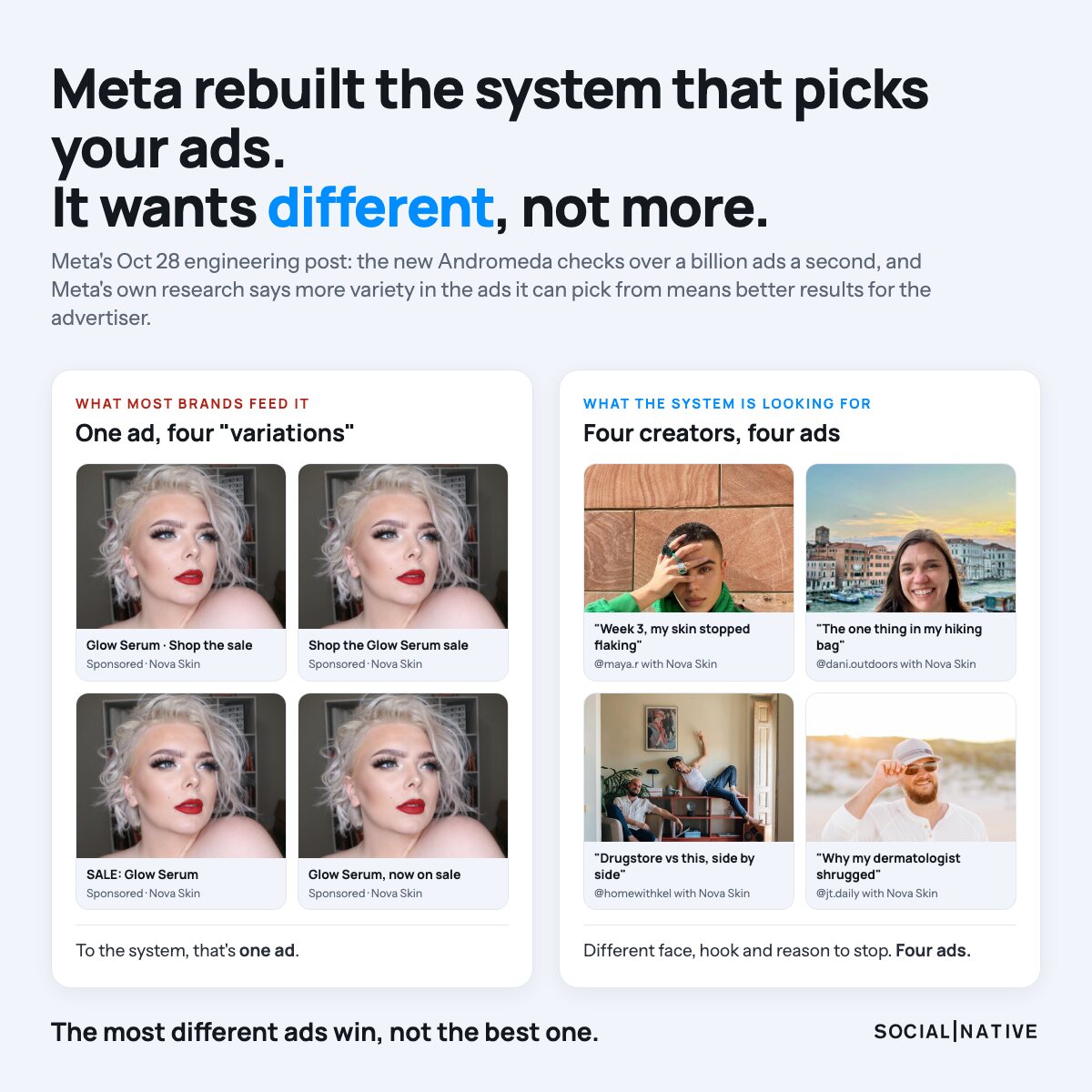
Put the two together and the operating rule is clear. With Advantage+ automating most targeting decisions, the creative is the main input an advertiser still controls, and the system is built to reward a wide spread of it. Ten headline variations on one video give the system one idea to work with. Ten different videos, from different people, with different hooks, give it ten.
What Meta has not said is just as important. Meta has not published a creative quota, a “creative similarity score,” or a threshold above which near-duplicate ads are suppressed. Those figures appear only on agency and vendor blogs. Treat them as marketing, not documentation.
What should brands do differently?
The upgrade does not punish any particular brand. It changes which playbook compounds.
| Old playbook | What works under the 2026 Andromeda |
|---|---|
| One hero ad, several copy and crop variants | Many distinct concepts: different people, hooks, formats and reasons to buy |
| Narrow manual audiences | Advantage+ automation fed with a diverse creative set |
| Refresh creative when frequency climbs and ROAS drops | A continuous pipeline of new creative, so fatigue never sets in |
| Brand-produced ads only | Creator content running as partnership ads alongside brand ads |
In practice that means four moves.
- Count concepts, not assets. Audit the live ad set. If most ads share one face, one shot and one message, you have one concept however many ad IDs exist.
- Plan for volume on a schedule. Creative fatigue on Meta arrives within weeks; the fix is a steady supply of new concepts, which we covered in why Meta ROAS drops after week two.
- Let the system choose. Broad placements and Advantage+ with a wide creative set give Andromeda the room it was built for.
- Make the creative legally portable. An ad can only be tested across organic and paid if the rights and permissions are in place first. What a creator post needs before it can run as an ad walks through it.
A five-question check on your current ad set. Answer yes or no:
- Do most of your live ads share one face or one shot?
- Are your “variations” mostly headline, crop or color changes?
- Has it been more than two weeks since a genuinely new concept went live?
- Does all of your creative come from one source, your studio or your agency?
- Would someone who scrolled past one of your ads recognize the next one as the same ad?
Three or more yes answers means the system is seeing one concept, whatever the ad count says.
Want the count done for you? A free Share of Views study shows how many distinct creators are already talking about your brand on TikTok and Instagram, how that compares with your competitors, and how much of it is paid versus organic. Request yours here; it takes us less than a day.
How do creators and partnership ads fit?
Creators are the most efficient source of ads that are different from each other. Twenty creators briefed on the same product produce twenty different people, settings, hooks and reasons to buy, which is exactly the spread Meta says its retrieval system is built to use. A brand studio producing twenty concepts from scratch is slower and costs more per concept.
The format already has Meta’s numbers behind it. Meta reports that adding partnership ads, which run under the creator’s handle with the paid-partnership label, delivers 19% lower cost per acquisition and 13% higher click-through rates on average (reported from Meta’s own press materials). We argued the creator side of this before the upgrade in why Andromeda is a creator partnership ads win, and compared formats in creator ads vs. brand ads. The October upgrade strengthens the case: the system that decides which ads get considered now runs at a scale where variety is the input that matters.
The Social Native platform is built for this loop. Brands brief creators at volume, see which creator posts earn views on their own, choose which ones to put paid spend behind as partnership ads, and report organic, paid and total results for the same asset side by side.
What Meta has not announced
- No creative count. Meta has not published a minimum or recommended number of ads per ad set for the new system.
- No similarity score. Nothing in Meta’s engineering or business posts describes a score that penalizes similar creative.
- No guaranteed lift. The 2.4% conversion figure is Meta’s Facebook-wide average since 2025, not a per-account promise.
- No change to the ranking stage. The October post covers retrieval only; ranking models were not part of the announcement.
The safest reading of the upgrade is also the simplest: Meta built a system that can look at a billion ads a second and told advertisers it works better when those ads are different. The brands that take that literally will be the ones it rewards.
Frequently asked questions
Does Meta Andromeda use a creative similarity score?
No published one. Meta’s engineering posts say the retrieval system is built to surface “a more diverse set of ad candidates” and that ad diversity drives better advertiser outcomes, but no score, threshold or penalty for similar creative appears in any Meta documentation. Those figures come from agency blogs.
How many ads should an ad set have under Andromeda?
Meta has not published a minimum or a recommended count. The guidance that exists is about variety: more genuinely different concepts give the system more to choose from, which is why creator content fits it well.
Does the Andromeda update affect Instagram ads too?
Yes. Meta’s December 2024 post describes Andromeda’s deployment across Instagram and Facebook. The 2.4% conversion lift Meta reported in October 2026 is specifically a Facebook figure.
Did the October 2026 Andromeda update change targeting?
Not directly. The October post covers retrieval only, the stage that chooses candidate ads; targeting and the final ranking stage were not part of the announcement. With Advantage+ automating most targeting, the creative is the input advertisers still control.
Citations
- Meta Engineering (Oct 28, 2026): Meta Andromeda, powering the next generation of ads retrieval through model-system co-design
- Meta Engineering (Dec 2, 2024): Meta Andromeda, supercharging Advantage+ automation with the next-gen personalized ads retrieval engine
- Meta for Business (Mar 27, 2025): AI innovation in Meta’s ads ranking driving advertiser performance
- Marketing Dive (Dec 2025): Meta streamlines brands’ creator partnerships with AI-powered updates (19% lower CPA, 13% higher CTR)