To plan a 2027 creator or influencer marketing budget, start from the result you need, then work back to what creators must deliver to get it. Budget five lines, not one: creator fees, product and shipping, paid media to boost the best posts, content rights, and measurement. Then phase the money across the year, with an always-on base and a reserve for trends.
Creator fees are the line every plan includes. A budget that covers only fees buys posts; one that also covers rights and paid media buys a library of ads you can keep running.
How much are brands spending on creators?
More every year, and faster than the rest of media. The IAB’s creator ad spend research puts the US market here:
| Measure | Figure | Source |
|---|---|---|
| US creator ad spend, 2021 | $13.9 billion | IAB, Nov 2025 |
| US creator ad spend, 2024 | $29.5 billion | IAB, Nov 2025 |
| US creator ad spend, 2025 (projected) | $37 billion, up 26% year over year | IAB, Nov 2025 |
| US creator ad spend, 2026 (expected) | $44 billion | IAB, Nov 2025 |
| Creator ad buyers who call creators a “must buy” | 48% | IAB, Nov 2025 |
| Ad type getting the most increased focus in 2026 | Creator and influencer advertising, at 54% | IAB, Sep 2026 |
The IAB found 2025 creator spend growing nearly four times faster than the media industry overall (IAB). In its September 2026 update, creator and influencer advertising topped the list of ad types buyers are focusing on more (IAB). For a 2027 plan, that means competitors in your category are likely spending more on creators too, so measure where you stand before you set the number. These figures come from the IAB’s 2025 report; we will update this page when the 2026 edition is published.
What percentage of your marketing budget should go to influencers?
There is no reliable industry percentage. The figures that circulate come from vendor surveys with different samples and questions, and the right share depends on what creators do for you: awareness, ad creative, sales, or all three.
Work the number out from your goal instead, as in the next section, then compare it with what you spend on other channels that do the same job. If creators supply your best-performing ads, they should be budgeted like a media channel, not like a test.
How do you decide how much to spend on influencer marketing?
From the goal, not from last year’s number. Each goal sets a different unit to buy, and the budget is that unit times the amount you need:
| Goal | What you are buying | How to size it |
|---|---|---|
| Awareness | Views from the right audience | Target views divided by expected views per post, times cost per post |
| Sales | Ads that convert, built from creator posts | Target sales × your cost per acquisition, plus the creator content to feed the ads |
| Content | Videos and photos for ads, product pages and email | Assets needed per channel per month, times cost per asset with rights |
| Share of the conversation | More creator views than your competitors | The gap between your views and the category leader’s |
An example, with round numbers for illustration only: a brand wants 5 million views from its target audience in a quarter. If creators in its category usually earn about 50,000 views a post, it needs around 100 posts. At $1,000 a post, that is $100,000 in creator fees, before product, paid media, rights and measurement. Replace each number with your own from past campaigns.
The last row is the one most plans skip. Measuring share of voice in creator content shows how far behind or ahead of competitors you are, which turns “spend more on creators” into a target. Competitor influencer analysis shows which creators are already doing it for them.
What should a creator marketing budget include?
Five lines. Leaving any out is how a plan runs short in the second quarter:
| Budget line | What it covers | Often missed |
|---|---|---|
| Creator fees | Payment for each post or video | Fees differ widely by platform, niche and creator size |
| Product and shipping | Product sent to every creator, plus delivery | Creators who post late because the product arrived late |
| Paid media | Boosting the best posts as partnership ads or Spark Ads | Planned after the posts go live, so the money isn’t there |
| Content rights | Permission to run creator content in ads and on your own channels | Short rights windows that end while an ad is still working |
| Measurement and tools | Tracking, reporting and the platform or team that runs it | Reporting that counts posts, not results |
For what creators charge by size and format, see influencer marketing pricing in 2026.
How much should go to paid media behind creator posts?
Enough to boost every post that proves itself. Organic results vary from post to post, and paid media is how you put more people in front of the ones that work.
Meta reports that adding partnership ads to business-as-usual campaigns delivers 19% lower CPAs and 13% higher click-through rates, on average (Meta). Two budget decisions make that possible:
- Agree ad rights in the creator contract. A post you can’t run as an ad can’t be boosted, however well it does. Negotiating rights after the fact costs more and takes time.
- Hold the paid budget until results come in. Pick the posts to boost on how they performed organically, not on which creator was most expensive.
Turning creator posts into paid ads covers how to pick and run them.
How should you spread the budget across the year?
As an always-on base with peaks around your selling moments, plus a reserve you don’t assign in advance.
- Always-on base. A steady group of creators posting every month keeps you in the conversation between launches. Long-term creator partners already know the brand, so each new brief is shorter.
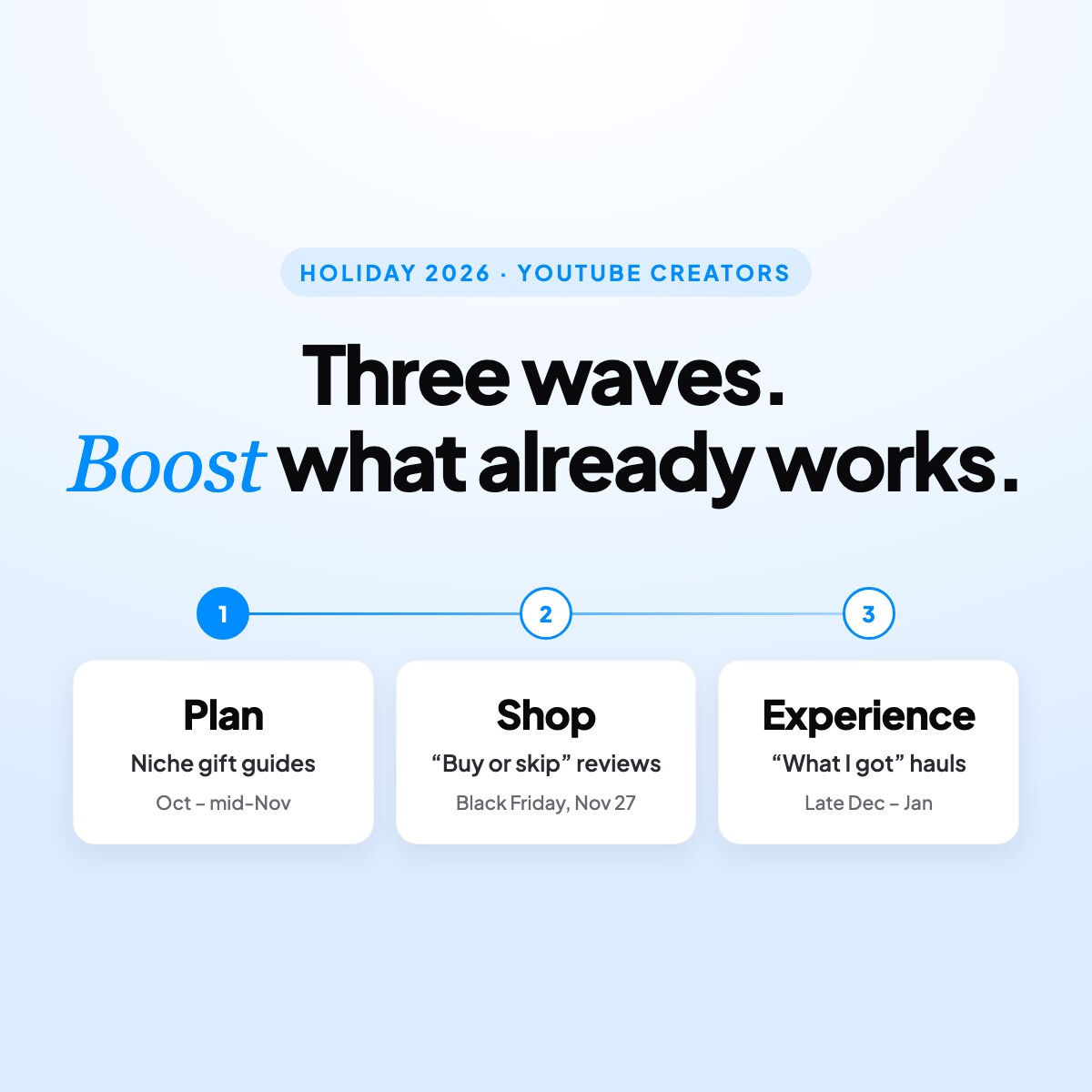
- Peaks for launches and seasons. Add creators and paid media around product launches and your category’s busy season. Book them well ahead, so the creators you want are free.
- A trend reserve. Keep part of the budget unassigned, so you can brief a creator within days when a trend fits. Spotting a TikTok trend before it peaks only pays off if the money is there to act.
- A quarterly review. Move money from the creators and formats that underperform to the ones that work.
How do you show the budget worked?
Decide how you will measure it before you spend it. Set the target for each goal in the plan, then report on results by creator and by video, not by campaign total. Creative-level reporting shows which videos earned their cost and which didn’t, which is what the quarterly review needs.
Report against competitors too. A year-on-year gain can still mean losing ground if your category grew faster.
Where do you start for 2027?
With where you stand today. In the Social Native platform, Share of Views compares your creator views with your competitors’ on TikTok, Instagram and YouTube and shows which creators drive them, and Trends Analysis shows what is working in your category each week. Together they show how big the gap is and where to spend first. You can’t size the gap to a competitor until you have measured it, and that is what a Share of Views study does.
Citations
- IAB — Creator Economy Ad Spend to Reach $37 Billion in 2025, Growing 4x Faster than Total Media Industry (November 20, 2025)
- IAB — 2025 Creator Economy Ad Spend & Strategy Report
- IAB — IAB Raises 2026 U.S. Ad Spend Forecast to +12.3% YoY Growth (September 10, 2026)
- Meta for Business — New AI-powered tools to scale creator and brand partnerships (December 11, 2025)