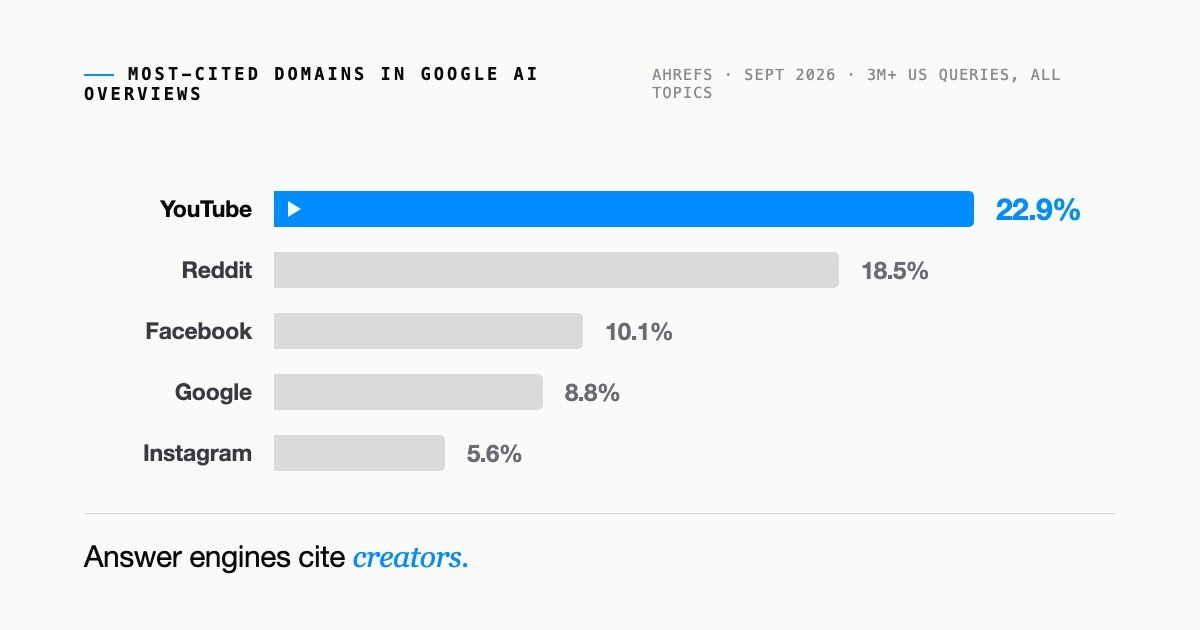
Subscriber count is the number most brands use to pick YouTube creators, and it is the weakest signal on the page. It records how many people once clicked subscribe — not how many still watch, how long they stay, or whether they resemble the audience you are trying to reach.
The metrics that predict whether a collaboration works — audience demographics, average view duration, engagement rate — are held by YouTube, not published on the channel. Getting at them is a permissions problem, not an analysis problem.
Why is subscriber count such a weak signal?
Because it measures a decision someone made once, possibly years ago, and never revisited. Three specific failures follow:
- It is cumulative and never decays. A channel that was prolific in 2022 and quiet since carries the same subscriber number as one growing now. Nothing about the figure distinguishes them.
- It says nothing about who those people are. Two channels of identical size can have entirely different audiences by age, country and language. The brief usually specifies exactly those things.
- It is not watch time. On a platform where the meaningful unit is how long someone stays, subscriber count does not describe attention at all. A large channel whose viewers leave after twenty seconds is worse than a small one whose viewers finish.
View counts are better, but only slightly — they are visible on the video, not the audience, and they mix organic reach with whatever paid support sat behind it.
What actually predicts whether a creator collaboration works?
Deloitte's 2026 Digital Media Trends survey of 3,518 US consumers measured purchase likelihood against three conditions, and none of them is reach.
| Condition | Purchase likelihood |
|---|---|
| Influenced by a creator they trust | 2.5x higher |
| Perceives creator ads as authentic | 2.0x higher |
| Repeatedly engages with the same creators | 1.2x higher |
Trust and repeat engagement are relationship properties. The same survey found 70% of people who engage with creators return regularly to the same ones — so the audience most worth reaching is one that comes back, and subscriber count cannot tell you whether it does. We made the longer version of that argument in do long-term creator partnerships actually perform better?
Where does the better data live?
Inside YouTube. Audience demographics, average view duration, engagement rate and brand-safety signals exist in every creator's analytics, and none of it is public. Historically a brand had three options, all bad: take the creator's word for it, accept a screenshot, or buy on subscriber count and find out afterwards.
YouTube changed that with its Creator Partnerships programme, expanded at NewFronts in March 2026 to 24 partners. When a brand deal is reported through an approved partner platform, that reporting acts as the consent mechanism allowing YouTube to share the creator's non-public metrics with the brand, for creators who have opted into sharing.
There is no self-serve route — access is limited to companies with a direct business relationship with YouTube, so brands and agencies reach the data through an approved partner. Social Native is integrated with the Creator Partnerships API, which means this data is available on YouTube campaigns run through the platform.
Is this the same thing as YouTube Shopping?
No, and the two get confused constantly because both involve creators earning money on YouTube.
YouTube Shopping is creator-facing and self-serve. A creator in the Partner Program with at least 500 subscribers tags products in their videos and earns commission on what sells. There is no brand relationship and no negotiation — a brand sets a commission rate and creators choose whether to promote the product.
Creator Partnerships is contract-first. A brand and a creator agree a deal, the deal is reported through an approved partner platform, and that report is what unlocks the audience data. The incentive can be a flat fee, a gift, affiliate commission, or a combination.
They meet at one point: affiliate commission is a valid incentive inside a brand deal, so YouTube Shopping can be the payment rail within a Creator Partnerships arrangement. But only one of them gives a brand visibility into who is watching, and it is not the self-serve one.
How should you evaluate a YouTube creator instead?
In this order:
- Audience composition against the brief. Age, country and language, from the platform rather than from a media kit. This is the filter that removes most candidates, and doing it first saves the rest of the work.
- Average view duration. Whether people actually watch. A channel with modest views and high completion is a better buy than a large channel people abandon.
- Whether the audience returns. The 70% figure is an average, not a promise. A creator whose viewers come back compounds your exposure; one with high reach and low return sells you a single impression.
- Delivery history. Whether they post on time, to brief, with usable assets. Entirely separate from audience quality and just as capable of wasting a campaign — see vetting creators on delivery, not just reach.
Subscriber count survives as a rough bound on scale. It should be the last thing you look at, not the first.
What changes once you can see the real numbers?
Mostly, which creators you pick — and that is the point. Better reporting after the fact is worth less than a better shortlist beforehand, because by then the money is spent.
Two things follow. Re-booking gets easier to justify, because you can see whether a creator's audience matched the brief rather than inferring it from results. And paid amplification gets more precise: a creator post that held attention is a different candidate for spend than one that merely reached people, which is the distinction behind turning creator posts into ads that actually run.
None of this makes YouTube easy to measure. It makes it measurable at all, which is a bigger change than it sounds for the platform where brands have had the least visibility and the most to gain.