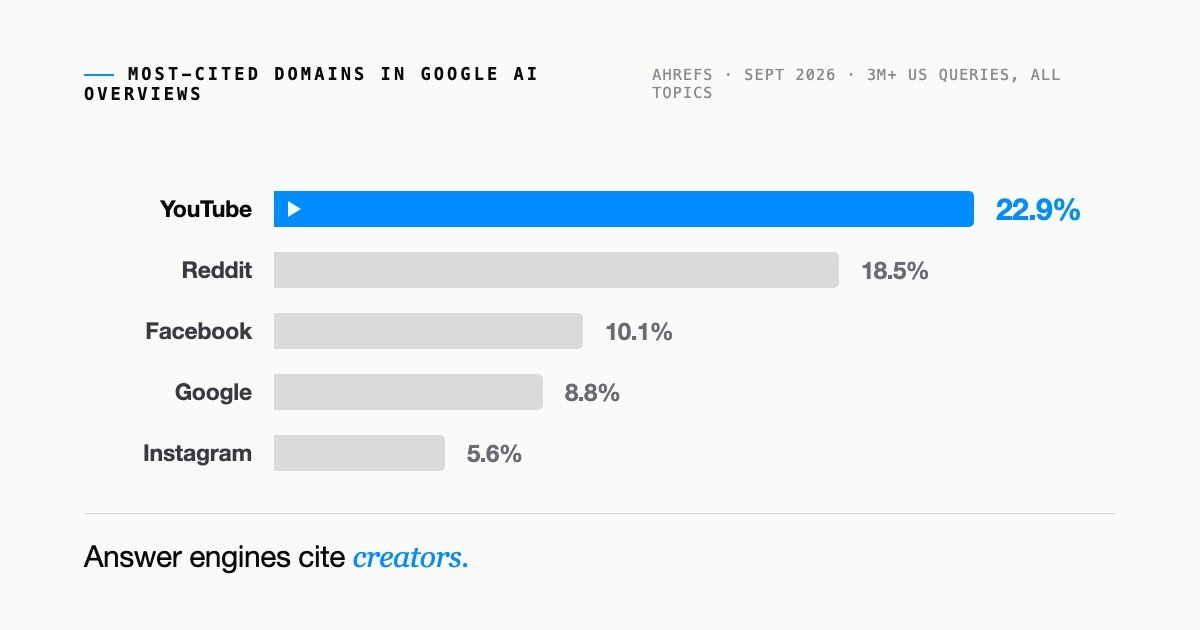
Ask ChatGPT, Perplexity, or Google’s AI Mode which product to buy and the answer is assembled from sources the engine trusts — and no single domain earns more of those citations than YouTube. It is the most-cited domain in Google’s AI Overviews, at 22.9% of citations across 3 million+ US queries — ahead of Reddit, Facebook, and every publisher. And in Ahrefs’ study of 75,000 brands, YouTube brand mentions were the single strongest predictor of AI visibility measured — far ahead of backlinks. Answer engine optimization, in practice, is less about rewriting your website and more about earning creator content that answers your buyers’ questions.
What is answer engine optimization (AEO)?
Answer engine optimization (also called generative engine optimization, or GEO) is the practice of earning presence in AI-generated answers — Google’s AI Overviews and AI Mode, ChatGPT, Perplexity, Gemini — rather than in ranked lists of links. The mechanics differ from SEO in one decisive way: an answer engine composes a short response from a handful of sources it trusts, so being cited is closer to being quoted by a journalist than to ranking on a results page. Your own site is one voice in that process. Third-party corroboration — who else talks about you, and how credibly — carries the rest.
Why does creator content decide which brands AI recommends?
Ahrefs analyzed 75,000 brands and millions of AI responses across ChatGPT, Google AI Mode, and AI Overviews to find which signals actually correlate with a brand appearing in AI answers. The off-site signals won — and video won overall:
| Signal | Correlation with AI visibility |
|---|---|
| YouTube brand mentions | ~0.74 — the strongest signal measured |
| Branded web mentions | 0.66–0.71 depending on platform |
| Backlinks | ≈0.22 — “very weak” |
Backlinks — the currency of two decades of SEO — barely register. What registers is being talked about, on camera, by people who are not you. That inverts the usual content playbook: the AEO asset most brands haven’t built is not another landing page — it is a body of creator and UGC content that answers category questions credibly.
Which platforms do AI engines cite most?
In Google’s AI Overviews, the most-cited domains are social and video platforms, not publishers (Ahrefs Brand Radar, September 2026, 3M+ US queries):
| Domain | Share of AI Overview citations |
|---|---|
| YouTube | 22.9% |
| 18.5% | |
| 10.1% | |
| Google properties | 8.8% |
| 5.6% |
The video lever is not uniform across engines. OtterlyAI’s analysis of 100 million+ AI citation instances found that of all the YouTube citations it observed, 38.7% came from Perplexity, 36.6% from Google AI Overviews, and 19.6% from Google AI Mode — while ChatGPT produced just 4.4%. So creator video earns you the Google surfaces and Perplexity, and community platforms like Reddit carry more weight on ChatGPT.
The mix also shifts with the query. On non-branded shopping questions (“best X,” “where to buy Y”), LLM Pulse’s analysis of 391,000+ citations found that most citations point to brand and manufacturer websites (64.7%) — while major retailers and marketplaces took just 2.9%, and Reddit and YouTube together out-cited every big-box retailer combined by 3.6 to 1. Read those two numbers together: on the queries where purchases get decided, answer engines lean on what brands publish and on what creators and communities say — not on storefronts. Your own pages are the part you already control. The creator layer is the earnable third-party voice most brands haven’t built. A serious AEO program tracks its answer share per engine and per query type, rather than assuming one tactic moves them all.
Do creators need big audiences to influence AI answers?
No — and this is the finding that changes the economics. In OtterlyAI’s YouTube citation study, views, likes, and subscriber counts showed near-zero correlation with citation frequency. Videos from channels with almost no subscribers earned citations alongside major ones. What did correlate: long-form video (94% of citations, against 5.7% for Shorts), structured descriptions (0.31 correlation), timestamps and chapters, and — above all — actually answering the question completely.
An answer engine cites the best answer, not the biggest channel. That means a fleet of long-tail creators, each answering a real buyer question properly, out-earns a single celebrity sponsorship for AI visibility — at a fraction of the cost. Reach still matters for humans; for the machines assembling answers, coverage of the question map is what compounds.
How do brands earn AI citations with creator content?
The playbook that follows from the data:
- Map the questions. Run your category’s buying questions through each engine and record who gets cited. That baseline — your share of AI answers, per engine — is the KPI everything else moves.
- Brief creators to answer, not to advertise. Long-form video, question-shaped titles, chapters, complete answers. The brief matters more than the roster: a video that resolves the question earns citations that a polished ad never will.
- Activate a fleet, not a hero. Covering a question map takes volume — dozens of creators across dozens of questions. This is where a creator marketplace at scale becomes the operating advantage: Social Native matches briefs to creators from a 2M+ creator marketplace, informed by 1.8M+ collaborations we have executed end to end.
- Measure, then put paid behind the winners. Re-run the question map quarterly and watch which content earns citations. The same creator content that wins organically can carry paid: Meta-measured partnership ads deliver 19% lower CPAs and 13% higher CTRs than business-as-usual ads.
And keep your own house in order — structured data, a real FAQ, honest claims with sources. Answer engines cross-check; a site that reads like marketing gets treated like marketing.
Creator marketing and search have been separate budgets for a decade. AI answers collapse them: the content that persuades a human on TikTok or YouTube is now also the content that teaches a machine which brand to recommend. The brands that treat creators as their answer-engine layer — briefed against real questions, measured by citation share, scaled through paid — will be the ones the machines mention first.
Citations
- Ahrefs — The 50 Most-Cited Websites in Google AI Overviews (September 2026)
- Ahrefs — AI brand visibility correlation study across 75,000 brands
- OtterlyAI — YouTube AI Citation Study 2026 (100M+ citation instances)
- LLM Pulse — Where AI Actually Sends Shoppers (391K citations, non-branded shopping queries, Apr–Jul 2026)