A share of voice report is accurate when two things hold: every post it counts is actually about the brand it credits, and it found the right social accounts for every brand in the comparison. Most errors trace back to one of those two.
Check both before you act on the number. Then read it against your own previous report, run on the same brands, dates and platforms, rather than on its own.
Why do two share of voice reports give different numbers?
Because they measure different things under the same name. Two tools can run on the same month of TikTok and Instagram and still disagree, and neither has to be broken. Before you decide which one is wrong, line up the choices each report made:
| Choice | Where reports differ | What it does to the number |
|---|---|---|
| Denominator | Views, posts, engagements or mentions | Posts reward volume; views reward content that travels |
| Competitive set | Which brands are in the comparison | Add a large rival and every other brand’s share falls |
| What counts as a mention | Keyword, hashtag, tag or a direct brand name | Loose rules credit posts that are not about the brand |
| Accounts matched | Which handle each brand is tied to | A wrong match inflates or erases a brand |
| Window and platforms | Dates covered and networks included | A seasonal spike or a missing platform reads as a share shift |
The first two are definitional, and both answers can be legitimate. The share of voice guide explains why views are the right denominator and how to fix a competitive set. The last three are accuracy questions, and they are where a report goes wrong.
Why is my social listening tool counting the wrong posts?
Because it counts posts that match a word, not posts about the brand. A post should count toward a brand only when it names or tags that brand. A keyword or hashtag match is not the same thing, and it is the most common source of false positives in a share of voice report.
The gap is a recognized research problem. RepLab, an evaluation campaign for online reputation monitoring, made it the first task systems had to solve: classifying each tweet that contained a company’s name as related or unrelated to that company, across a gold standard of more than 140,000 annotated tweets (Amigó et al., RepLab 2013). Researchers built a benchmark for it because matching on a name alone does not tell you what a post is about.
Brands whose names are everyday words are hit hardest. A brand named after a fruit, a color or a common noun collects posts that only share the word. Those posts land in its views, raise its share, and lower every competitor’s share with it.
What does a false positive do to the number?
A worked example, with illustrative figures. Three brands over 90 days; one of them, Juniper, shares its name with a plant, and 2.0M of the views credited to it come from posts about gin and gardening.
| Brand | Views as reported | Share as reported | Views from posts about the brand | Corrected share |
|---|---|---|---|---|
| Juniper | 6.0M | 60.0% | 4.0M | 50.0% |
| Brand B | 3.0M | 30.0% | 3.0M | 37.5% |
| Brand C | 1.0M | 10.0% | 1.0M | 12.5% |
| Total | 10.0M | 100% | 8.0M | 100% |
Juniper’s lead drops from 30 points to 12.5, and both competitors gain share without earning a single extra view. A false positive distorts every brand in the set, not just the one it is credited to.
The test is quick: open the highest-viewed posts credited to each brand and read them. If a brand’s top posts are not about the brand, its number is not either.
Did the report match the right account for every brand?
Check this before you read a single percentage. A competitor matched to a fan page, a regional account, a reseller or a similarly named company skews the whole comparison, because the views from that account stand in for the real brand’s.
Follower counts are the fastest sanity check. They are a poor measure of value, as why more followers doesn’t mean more value covers, but they are a good way to spot a wrong match. A national competitor showing a few thousand followers, or a small rival showing millions, points to the wrong handle. So does a brand with an Instagram account but no TikTok account when you know it posts on both.
How do you audit a share of voice report in ten minutes?
Run five checks, in this order. The first two catch the errors that change the answer; the last three catch the ones that change the trend.
| Check | What goes wrong if you skip it | How to spot it |
|---|---|---|
| 1. Accounts matched for each brand | A fan, regional or look-alike account inflates or deflates a rival | Follower counts far off what you would expect for that brand |
| 2. What counts as a mention | Unrelated posts that share a word or hashtag get counted | Read the top posts credited to each brand |
| 3. Same competitive set as last time | The trend line compares two different races | The brand list differs between reports |
| 4. Same window and platforms | A seasonal or platform swing looks like a share shift | The dates or platform list changed |
| 5. Sponsored vs organic split | Paid volume reads as earned attention | One brand’s share is mostly sponsored views |
If a report fails check 1 or 2, fix it and rerun it before anyone reads the result. If it fails check 3 or 4, the number may still be right, but you cannot compare it with the last one.
Is a competitor’s lead paid or earned?
Split every brand’s views into sponsored and organic before you conclude anything. A competitor who leads on sponsored views has bought reach, and that lead lasts as long as the budget. A lead built on organic views means creators and audiences are choosing to talk about them, which is harder to catch.
The platforms make the split possible because they ask creators to label commercial posts. TikTok’s content disclosure setting labels a post as “Paid partnership” or “Commercial content”, so viewers can see which posts are organic and which are commercial (TikTok). Instagram’s branded content policies require creators to tag the brand with its paid partnership label (Instagram). In the US, the FTC tells creators to disclose any financial, employment, personal or family relationship with a brand, and to use a platform’s disclosure tool in addition to their own disclosure (FTC).
Disclosure still depends on creators switching the label on, so treat the split as a strong signal rather than an audit of every post.
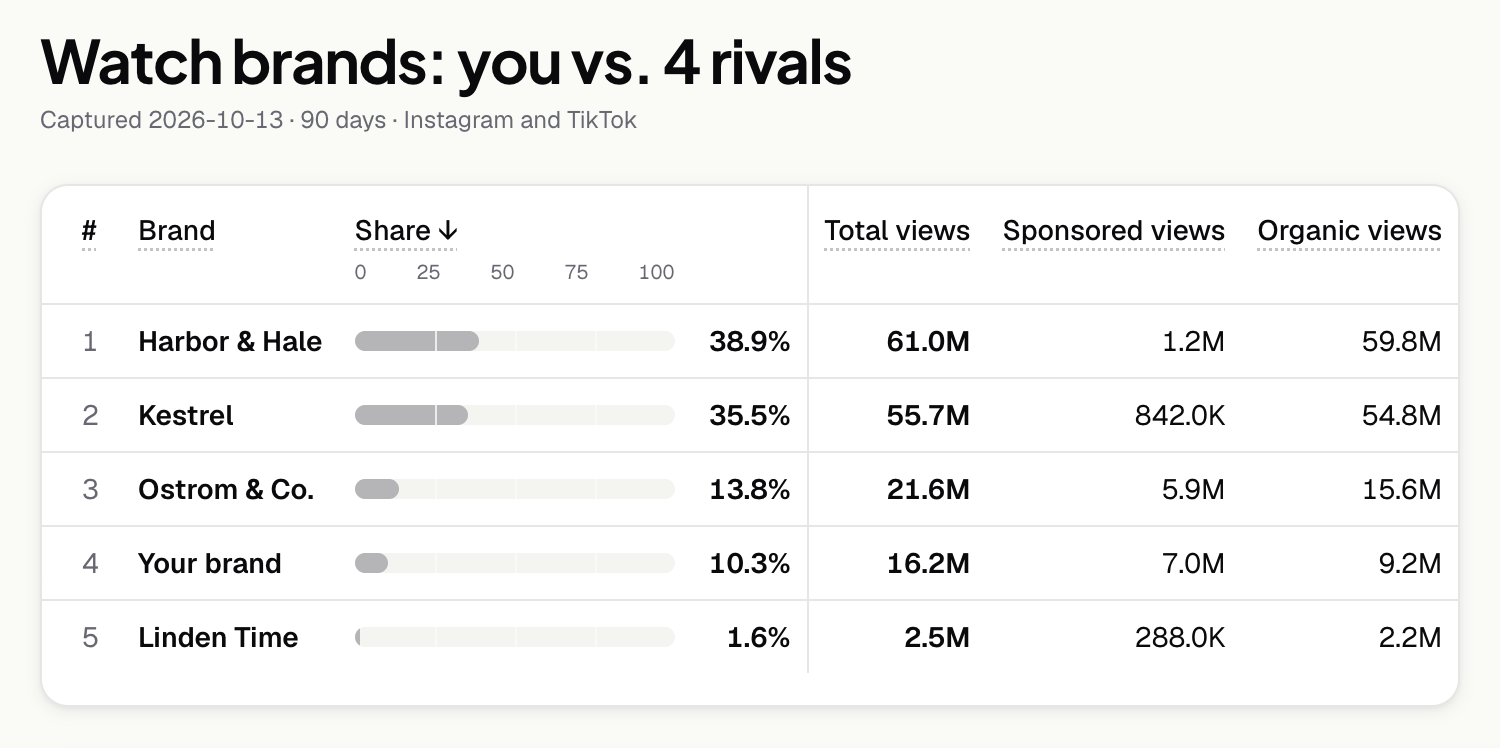
A Share of Views comparison on SocialNative.ai, with brand names changed. The brand fourth by share has more than 40% of its views from sponsored posts; the two leaders earn almost all of theirs organically.
The split tells you what to do next. Behind on organic views, the fix is content that travels, and the quickest lever is the creator videos you already have: find the ones that earn attention and put spend behind them by turning creator posts into ads. Behind a rival who is buying sponsored views, decide whether to match the spend or out-earn it.
Why is one report not enough?
A single report is a snapshot, and a snapshot cannot tell a breakout week from a trend. The number that matters is the direction: this quarter against last quarter, on the same set, window length and platforms.
Keep every report you run, and read each new one against the last. When a competitor jumps, open the weeks behind the jump. One viral video calls for a different response from a steady climb, and creative-level reporting shows which videos moved the number. Report share of voice on the same basis every quarter, too: a metric read on a shifting basis is why influencer ROI so often looks bad.
What should you ask your share of voice vendor?
Five questions, one for each way a report goes wrong. If the answer to any of them is no, you cannot audit the number you are paying for.
- What counts as a mention? A keyword or hashtag match, or only a post that names or tags the brand?
- Can I see the account matched to each brand, and correct it?
- Can I open the posts behind each brand’s number?
- Are sponsored and organic views reported separately?
- Can I rerun the report on the same brands, window and platforms, and keep past reports to compare against?
Can you see what your share of voice report counted?
Yes, on SocialNative.ai. Before a Share of Views comparison runs, brands can check the Instagram and TikTok account found for every brand and correct any that are wrong. Only posts that name or tag a brand count toward its share, and every report a brand has run stays available, so this month’s comparison can be opened next to last quarter’s.
Talk to us about share of voice reporting
Citations
- Amigó et al. — Overview of RepLab 2013: Evaluating Online Reputation Monitoring Systems, CLEF 2013 (Springer LNCS)
- TikTok Ads Manager Help — About the content disclosure setting for creators
- Instagram Help Center — How to use the paid partnership label to tag organic branded content
- Federal Trade Commission — Disclosures 101 for Social Media Influencers